
Drones
Many of the most powerful, memorable and effective photographs are black and white images. With digital photography though you can no longer take a great black and white photograph
Overview
COURSE DESCRIPTION
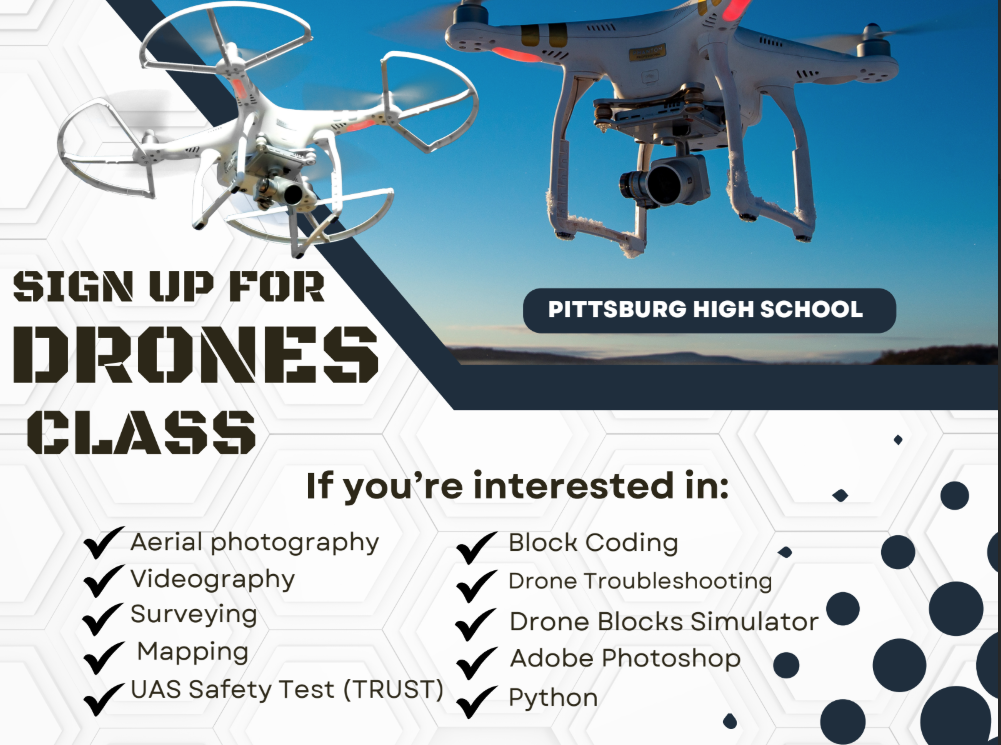
During this course, we will explore drones and how they function. Students will explore various types of drones and
how each varies from each other. We will also go over the history and how drones were created in the first place. By the
end of the year, students will be able to use drones confidently and professionally. Students will be experienced and
knowledgeable with topics such as safety procedures, UAS, flight operations, and UAV (Unmanned Aerial Vehicles).
Course Review:
During the first semester, students will first be introduced to Drone’s Introduction, the history of Drone, the Anatomy of
drones, Classification of Drones, Application of Drones and How to fly a Quadcopter. Students will also be introduced to
Tips for Aerial Photography, Drone Industry, Drone Manufacturing Process, High-tech in Drone, and Some Basic
Terminology. During the second semester, students will build their confidence with flying drones and will start becoming
proficient. Students will also learn how to properly code and assemble and disassemble their drones.
LEARNING OUTCOMES
-
Learning Outcomes – Semester 1
By the end of Semester 1, students will be able to:
-
Explain fundamental concepts of drone technology, including the history, evolution, and basic terminology related to unmanned aerial systems (UAS).
-
Identify and describe the anatomy and components of drones, including frames, motors, propellers, batteries, sensors, and flight controllers.
-
Differentiate between major classifications of drones based on size, function, and application areas.
-
Describe various applications of drones in industries such as agriculture, photography, logistics, defense, surveying, and environmental monitoring.
-
Demonstrate basic quadcopter flight skills, including take-off, landing, hovering, and directional control following safety guidelines.
-
Apply essential tips and techniques for aerial photography, including camera positioning, stability, and environmental considerations.
-
Explain the drone manufacturing process and identify key stages from design to assembly.
-
Describe advanced technologies used in modern drones, such as GPS, obstacle avoidance systems, stabilizers, and communication modules.
Learning Outcomes – Semester 2
By the end of Semester 2, students will be able to:
-
Demonstrate improved flight proficiency, including controlled maneuvers, obstacle navigation, and safe operation in more complex environments.
-
Assemble and disassemble drone components correctly, demonstrating understanding of mechanical and electrical integration.
-
Apply troubleshooting techniques to diagnose and fix common hardware or flight issues.
-
Write and modify basic drone-related code, such as for flight automation, sensor control, or simple mission programming.
-
Integrate hardware and software skills to prepare a fully functional drone ready for testing and flight.
-
Analyze and evaluate flight performance, using data (e.g., battery use, motor response, stability) to make improvements.
-
Demonstrate responsible drone operation, including adherence to safety rules, airspace regulations, and ethical considerations.
-
Curriculum
Instructor

You May Like


Website Design
Teacher: Mr. Goswami Room: F212 Web Design Course Syllabus: Course Description: During this course, we will explore how websites are made and designed to...

Introduction to Engineering Design
This tutorial will introduce you to PHP, a server-side scripting language you can use to make dynamic websites and web applications.

Game Design
The jQuery team knows all about cross-browser issues, and they have written this knowledge into the jQuery library. jQuery will run exactly the same...

Computer Science Discoveries:
In this course, We'll learn how to create websites by structuring and styling your pages with HTML and CSS.
Course Features
- Lecture 0
- Quiz 0
- Duration 55 hours
- Skill level All levels
- Language English
- Students 27
- Assessments Yes