Introduction to Engineering Design
This tutorial will introduce you to PHP, a server-side scripting language you can use to make dynamic websites and web applications.
Overview
COURSE DESCRIPTION
Welcome to Introduction to (Engineering) Design. This class also resumes detailed student experience with tools, software, lab work, and engineering design. The detailed skills listed within course resumes illustrate the immediate, applicable contributions that students can make within a workplace. Students can apply this class to multiple CTE pathways, art skills, and hands-on work.
This class is focused on how to go from thoughts inside your head, to ideas on paper, to modeling those concepts in 3D design software, to being able to get those designs 3D printed (extruded plastic) – and go the other way as well, reverse engineering an existing item back into its component concepts.
The goal of the class is to have clear, effective communication in multiple modalities (written, pictorial, and spoken!). This class will also cover how to document your work in ways that are clear, meaningful, and organized. Sometimes the difference between a copyright or naming rights is all in the documentation! The curriculum is STEAM and Engineering based, but the uses and applications are for all fields.
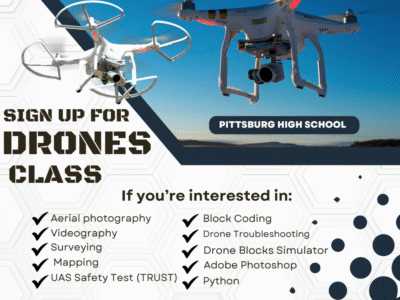
I teach Engineering, Game Design, Web design, drones, and the Computer Science Discoveries class. I look forward to meeting students and parents during student teacher conferences.
If you want to have a chat about your child’s progress, it would be better to schedule time NOT during class time so we can dedicate focus to your needs – Please email me at mgoswmi@pittsburgusd.net.
SCHOOL RULES AS PUBLISHED IN THE STUDENT HANDBOOK WILL BE ENFORCED.
If you do not know what the school rules are, in general, please do read through the student handbook. If you do not happen to have one, there should be a copy published on the Pitt High website.
Topics covered in the class are:
● Purpose and practice of modeling in (engineering) communication
● Modeling methods
● Technical sketching (by hand and by computer)
● 3D solid modeling
● Computer-Aided Design (CAD)
● Prototyping: multiple styles and ways! Building scale versions and testing.
● Troubleshooting a non-working multi-component mechanical device
● Design of systems of components
● Methods to improve the manufacturability of a product and reduce production costs creating 3D assembly models in CAD. Reverse engineering
● How to identify and select materials.
● How to investigate and document the design of multi-component systems
Curriculum
Instructor

You May Like


Website Design
Teacher: Mr. Goswami Room: F212 Web Design Course Syllabus: Course Description: During this course, we will explore how websites are made and designed to...
Game Design
The jQuery team knows all about cross-browser issues, and they have written this knowledge into the jQuery library. jQuery will run exactly the same...

Computer Science Discoveries:
In this course, We'll learn how to create websites by structuring and styling your pages with HTML and CSS.